
Creating sustainable livelihoods through crafts
What is EkiBeki ?
Eki (Marathi: EY-ki) - odd, unique, oneness
Beki (Marathi: BEY-ki) - even, common, duality, diversity
True to our name, EkiBeki brings together what may seem like opposites.
Through thoughtful design interventions, EkiBeki Association revives India’s folk arts and crafts and bridge the urban - rural divide creating contemporary relevance while enabling artisans to build sustainable livelihoods and strengthen craft communities in their natural habitats.

It began with Vishpala, as an architect, collaborating with diverse craftsmen on her projects. When she returned to work with the same artisans on a new initiative, she discovered that many had abandoned their traditional skills to become unskilled labourers in cities, in search of livelihood.
Determined to restore dignity to their craft and create sustainable livelihoods without forcing migration, EkiBeki was founded in 2018.


Reviving the beauty of yesteryears, contemporised for our generations
Our Impact - FY 26 and Cumulative
58/712
New designs created
285/ 1015
Artisans impacted directly
40/73
New partnerships developed
63/190
Number of crafts we work with
49K/58K
Engagement and awareness through workshops, projects, exhibitions
₹ 1 Cr./ ₹2.9 Cr.
Revenue generated by artisans

_edited.png)
Projects - What we do
Determined to restore dignity to craft and enable artisans to earn without migrating, EkiBeki emerged in 2018 as a social enterprise, an NGO committed to keeping traditional skills relevant in the modern world.
Awareness
Design inputs
Skill building
Livelihood generations
Market linkages
Engagement
Benefit sharing and reinvestment

Today, EkiBeki focuses on upskilling traditional artisans through modern design sensibilities, ensuring their age-old skills remain relevant. By finding new uses for traditional crafts, it creates fresh opportunities for livelihood, continuity, and meaningful connections.
EkiBeki works at the intersection of heritage and contemporary design. Through design interventions, skill and capacity building, product development, and market access, the NGO organisation identifies crafts on the verge of extinction and helps revive them into viable, self-sustaining livelihoods.

Our Journey
Recognising the limitations of an NGO in selling products, EkiBeki India Pvt Ltd was established to manage market linkages
Despite Covid-19, Several murals were executed for Starbucks, ensuring safety while continuing to create opportunities.
Kalaangan - our first large-format exhibition-was launched.

2017
It all started with Vishpala as an Architect noticing urban clients often preferred European art over Indian, highlighting how non-textile crafts remain overlooked
2026..
New website launch !
With everyone’s support, we hope to create greater revenue for upskilling our artisans, and ensure that our traditional arts find the space and voice they truly deserve.
EkiBeki was born as an NGO.
With the aim of reviving dying crafts
A step towards reversing migration.
Copper enamel work began in Alibag with just 2 families. the artisan’s son and daughter-in-law returned home to join the practice
Launch of our website marked our entry into the digital world. We began paying royalties to artisans for the use of their art
A sponsored exhibition brought together refined cultural storytelling
Our Presence
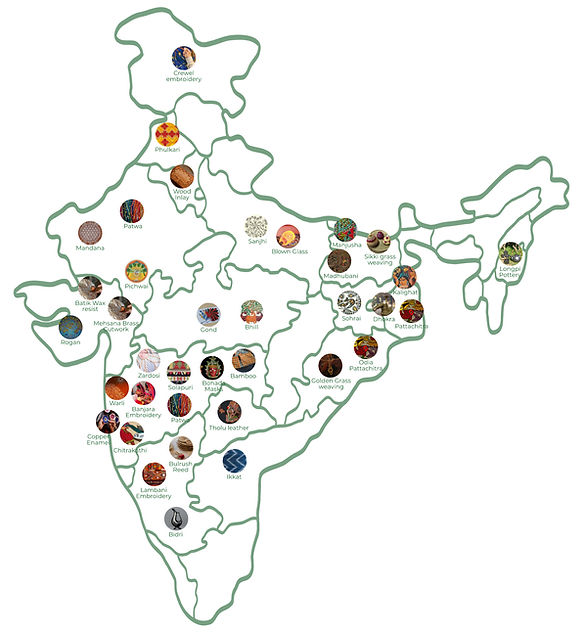
EkiBeki’s journey across India is not just about sourcing art- it is about building relationships, understanding traditions, and bringing together diverse creative languages into something beautifully unified.
From the intricate threads of Phulkari in Punjab to the earthy storytelling of Gond and Bhil art in central India, from the narrative richness of Chitrakathi in Maharashtra to the delicate patterns of Pattachitra in Odisha and West Bengal—EkiBeki works closely with artisans across regions, each rooted in their own history, materials, and ways of seeing the world. This presence is not incidental; it is intentional, built over time through trust, collaboration, and deep respect for craft.
Every region carries its own visual identity. Some are bold and graphic, others are rhythmic and detailed; some tell stories through figures, while others through patterns and textures. Traditionally, these art forms have existed within their own geographies, rarely intersecting. EkiBeki’s work begins at this intersection.
Partners who support us